
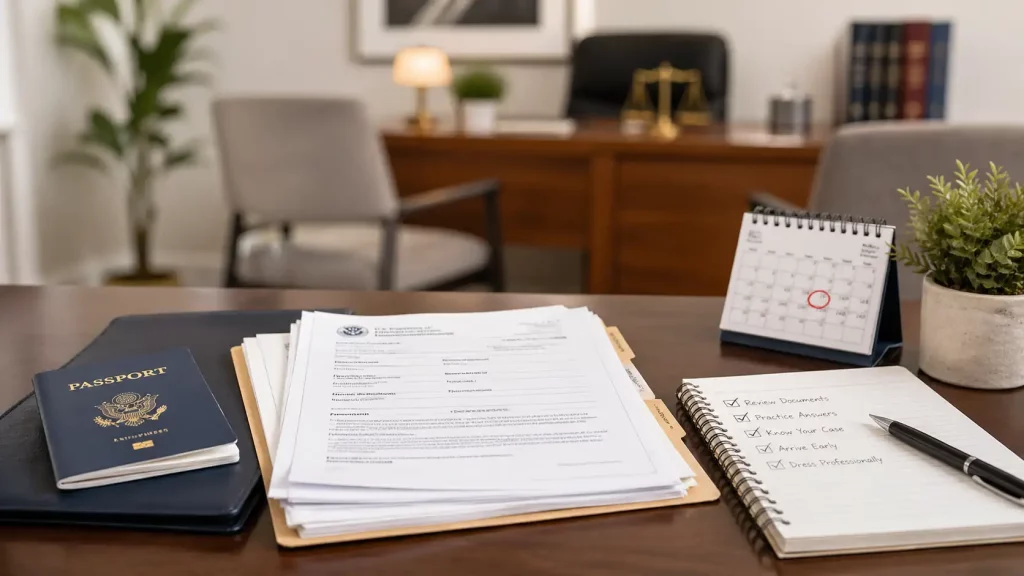
An immigration interview can feel overwhelming. Your future in the United States may depend on what happens in that room, and that pressure makes many people anxious. The good news: good preparation boosts your confidence and helps your interview go much more smoothly.
1. Know What Type of Interview You Have
Your preparation starts with understanding what kind of interview you will attend. Common types include:
- Green card (adjustment of status) interview at a local USCIS office
- Consular immigrant visa interview at a U.S. consulate or embassy abroad
- Nonimmigrant visa interview (tourist, student, work visa) at a consulate
- Naturalization (citizenship) interview
- Asylum or other protection interviews
Each type has a different focus:
- Green card and immigrant visa interviews: your eligibility and the truth of your supporting relationship or job
- Nonimmigrant visas: your purpose of travel and ties to your home country
- Naturalization: your eligibility, good moral character, and English/civics knowledge
Carefully read your appointment notice so you know:
- Which agency you are meeting with (USCIS or consulate)
- Date, time, and location
- Any special instructions (for example, medical exam, translations, security rules)
2. Review Your Application Line by Line
Before you walk into any immigration interview, you must know your own application.
Take time to:
- Print and review your entire application package (forms and documents)
- Read every answer you gave on forms like I-130, I-485, I-864, I-765, N-400, or visa applications (such as the DS‑160 or DS‑260)
- Make notes where information has changed since you filed (new job, new address, new child, travel outside the U.S., etc.)
Officers often ask questions that match the application exactly. If your answers do not match, it can look like:
- You do not understand your own case, or
- You are not being truthful
If something is different now (for example, a new job or address), be ready to explain the change clearly and honestly. Bring any updated documents that support these changes.
3. Gather and Organize Your Documents
Good document organization sends a strong message: you take your case seriously.
Bring All Required Original Documents
Carefully follow the instructions in your interview notice. Typical items include:
- Passport (current and sometimes expired ones)
- Government-issued photo ID
- Appointment notice
- Original birth certificates for you and any dependents
- Marriage certificate, divorce decrees, and prior spouse death certificates (if applicable)
- Green card, work permit, or travel document (if you already have them)
- I-94 record (if you entered on a visa)
Prepare Supporting Evidence
Depending on your case, you may need:
- Marriage-based green card cases
- Joint lease or mortgage
- Joint bank statements and credit card statements
- Utility bills in both names
- Photos together with family and friends
- Evidence of shared life (travel, messages, insurance, taxes, etc.
- Employment-based cases
- Job offer letter
- Pay stubs and employment verification
- Tax returns and W‑2s
- Professional licenses or certifications
- Naturalization cases
- Green card
- Tax transcripts
- Proof of any trips outside the U.S.
- Court records for any arrests or citations
Use a Simple, Clear System
To stay calm, organize everything:
- Use a binder or folders with labeled sections
- Put originals in one section and copies in another
- Add sticky notes or a checklist so you can quickly find what the officer asks for
If any document is not in English, bring a certified translation as required by USCIS or the consulate.
4. Practice Answering Common Questions
You do not need to memorize a script. However, practice helps you answer clearly and confidently.
Common topics include:
- Your biographical information (name, address, date of birth)
- Your immigration history (entries, exits, prior visas, prior applications)
- Your family relationships
- Your work and education history
- Any criminal history, arrests, or citations
- For marriage cases: how you met, daily life together, future plans
- For naturalization: questions from your N‑400 application and civics test
When you practice:
- Answer out loud, not just in your head
- Focus on short, honest answers
- Do not guess. If you do not know or do not remember, say so honestly.
If you and your spouse attend a marriage-based interview, practice together so your answers are truthful and consistent.
5. Plan How You Will Present Yourself
You do not need expensive clothes, but you should look neat and respectful.
Consider the following:
- Dress in clean, modest, business‑casual clothing
- Arrive early (at least 30 minutes before your appointment time)
- Learn about parking or public transportation for the location
- Do not bring food, drinks, or prohibited items into the building
- Turn off or silence your phone before entering the interview room
Your attitude also matters:
- Be polite and calm with officers and security staff
- Make eye contact when you speak
- Listen carefully and do not interrupt the officer
- Ask politely if you do not understand a question
6. Understand the Role of Interpreters
If you are not fully comfortable speaking English, you may need an interpreter.
- Check your appointment notice and agency rules about interpreters
- Choose someone who is fluent in both languages and can stay calm
- Remind them to interpret exactly what is said, not to explain or add comments
- Practice with your interpreter ahead of time, so the process feels natural
Never lie and say you understand English well if you do not. Misunderstandings can hurt your case.
7. Be Ready for Tough or Personal Questions
Some immigration interviews include very personal or sensitive questions, especially in marriage-based or fraud‑risk cases. Officers do this to check credibility and consistency.
To handle tough questions:
- Stay calm, even if a question feels unfair or uncomfortable
- Answer honestly and briefly
- If you do not understand, ask the officer to repeat or rephrase
- Do not argue or raise your voice
If a question touches on a criminal record, immigration violation, or past misrepresentation, it is very important to:
- Tell the truth, and
- Seek legal advice from an immigration attorney before your interview whenever possible
8. What to Do After Your Interview
When the interview ends, the officer may:
- Tell you their decision right away, or
- Tell you that a decision will be mailed after further review, or
- Request additional documents (a Request for Evidence, or RFE)
After the interview:
- Write down what happened, including any concerns or unusual questions
- Keep copies of any documents the officer gave you
- If the officer asked for more evidence, collect it quickly and send it by the deadline
- Track your case status online using your receipt number
If your case is delayed or you receive a request for evidence or notice of intent to deny, contact a Houston immigration attorney right away to review your options.
9. How a Houston Immigration Attorney Can Help You Prepare
U.S. immigration law is complex, and small mistakes in an interview can lead to delays, denials, or even removal proceedings in serious situations. Working with an experienced attorney gives you valuable support.
An immigration attorney such as Nisreen Mousa can:
- Review your entire immigration history and spot issues before the interview
- Help you correct errors or update your application when allowed
- Prepare a well‑organized document package for the officer
- Conduct a mock interview so you know what to expect
- Attend your interview with you in many types of USCIS cases
- Advise you on next steps if the officer requests more evidence or does not decide right away
Most importantly, a knowledgeable Houston immigration attorney focuses on protecting your rights and your future in the United States, so you do not face the process alone.
Final Thoughts
Preparing for your immigration interview takes time and effort, but you do not have to feel powerless. When you:
- Understand the purpose of your interview
- Carefully review your application
- Bring organized, complete documents
- Practice clear, honest answers
- And seek guidance from a trusted Houston immigration attorney
You give yourself the best possible chance at a successful result.
If you have an upcoming immigration interview in Houston or the surrounding area, consider reaching out to Attorney Nisreen Mousa to discuss your case and create a preparation plan tailored to your situation. Early preparation often makes a real difference in the outcome.
The Law Firm of Nisreen S. Mousa, P.C. 3730 Kirby Drive, Suite 1200 Houston, TX 77098 Phone: (713) 828‑0365 Website: https://nisreenmousalaw.com